The History of England, Volume 5 by Peter Ackroyd
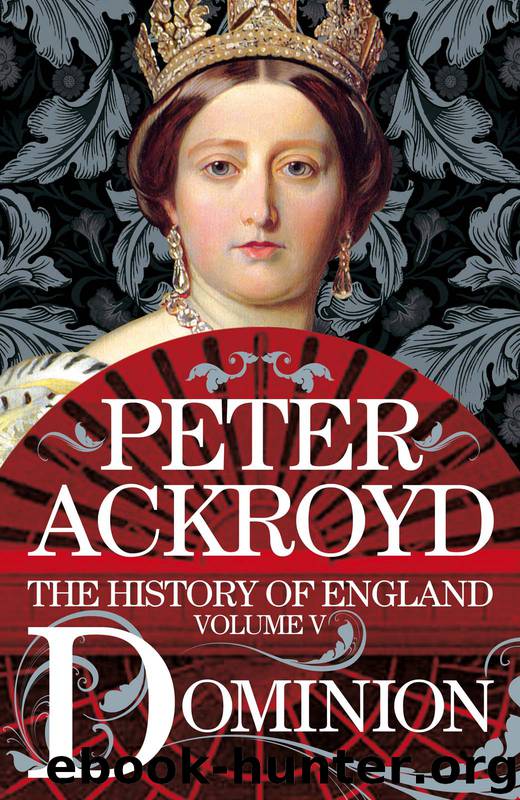
Author:Peter Ackroyd
Language: eng
Format: epub
Publisher: Pan Macmillan UK
Nightingale was not the only woman to devote herself to the sufferings of the soldiers. One other such was Mrs Mary Seacole, a ‘quadroon’ from the British West Indies who confronted prejudice against her sex and her race simply by knocking it down. Like many formidable women (Lady Hester Stanhope is another shining example from a period just before), she had a confirmed and powerful wanderlust. ‘I have never wanted [lacked] inclination to rove’, she wrote, ‘nor will powerful enough to carry out my wishes.’ This was the antithesis of the Victorian idea of a woman, immured in the house as a domestic prisoner. How much is ‘the angel in the house’ a masculine illusion foisted upon frustrated wives who may have had adventurous spirits as powerful as that of Mary Seacole?
She acquired many of her skills at the British Army Hospital in Jamaica, where yellow fever in particular led to many deaths. Of her decision to minister to the soldiers of the Crimea, she remarked that ‘heavens knows it was visionary enough’. But she recalled that in ‘the ardour of my nature, which carried me where inclination prompted, I declared that I would go to the Crimea’. She was not at first welcome, since Florence Nightingale had doubts about a non-white nurse, and she was also rebuffed by the War Office and the Medical Department. Eventually she decided to make her own path and to bypass the authorities by opening a hotel for invalids. Cards were printed and distributed in the war region, announcing a ‘BRITISH HOTEL’ where she intended ‘to establish a mess-table and comfortable quarters for sick and convalescent officers’.
The fame of her skills as a healer and nurse soon spread. She called her patients ‘sons’ and she was universally known as ‘Mother Seacole’. As soon as she arrived on the Crimean peninsula she learned that ‘the hospitals were full to suffocation, that scarcity and exposure were the fate of all in the camp’. She built up a cadre of female nurses of whom she said that ‘only women could have done more than they did who attended to this melancholy duty; and they, not because their hearts could be softer, but because their hands are moulded for this work’. It may not be going too far to suggest that without the unacknowledged assistance of the women the men would not have survived. Mary Seacole returned to England and died in May 1881.
Download
This site does not store any files on its server. We only index and link to content provided by other sites. Please contact the content providers to delete copyright contents if any and email us, we'll remove relevant links or contents immediately.
| Africa | Americas |
| Arctic & Antarctica | Asia |
| Australia & Oceania | Europe |
| Middle East | Russia |
| United States | World |
| Ancient Civilizations | Military |
| Historical Study & Educational Resources |
Room 212 by Kate Stewart(5136)
The Crown by Robert Lacey(4825)
Endurance: Shackleton's Incredible Voyage by Alfred Lansing(4793)
The Iron Duke by The Iron Duke(4370)
The Rape of Nanking by Iris Chang(4228)
Joan of Arc by Mary Gordon(4123)
Killing England by Bill O'Reilly(4015)
Say Nothing by Patrick Radden Keefe(3994)
I'll Give You the Sun by Jandy Nelson(3455)
Shadow of Night by Deborah Harkness(3382)
Hitler's Monsters by Eric Kurlander(3355)
Mary, Queen of Scots, and the Murder of Lord Darnley by Alison Weir(3220)
Blood and Sand by Alex Von Tunzelmann(3210)
Eleanor & Park by Rainbow Rowell(3192)
Darkest Hour by Anthony McCarten(3138)
Margaret Thatcher: The Autobiography by Thatcher Margaret(3090)
Book of Life by Deborah Harkness(2948)
Red Famine: Stalin's War on Ukraine by Anne Applebaum(2944)
The One Memory of Flora Banks by Emily Barr(2872)
